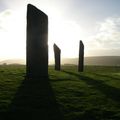
Sacra di San Michele, history
 The
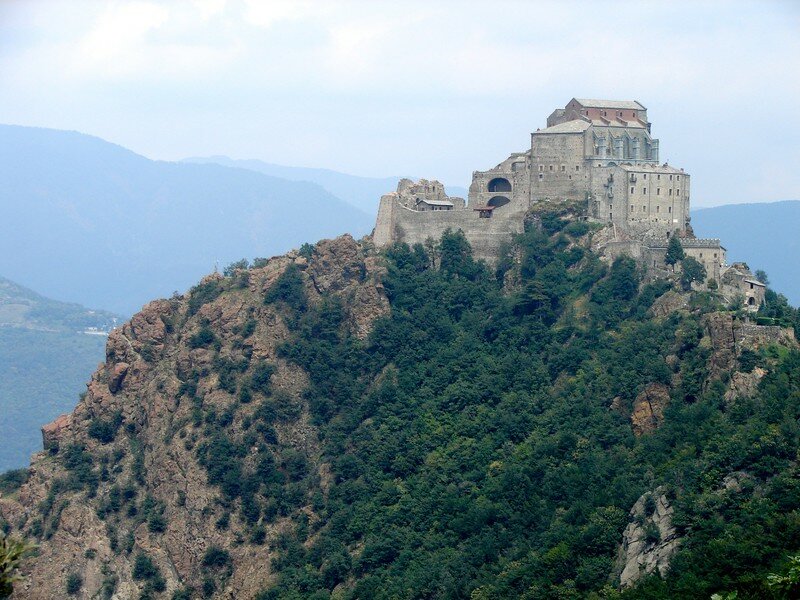
Pirchiriano mount, on the slope of which is Sacra it di san Michele,
dominates with 962m, and is drawn up in the valley of Suse, not far
from Turin. The valley was formed in the time of the ice ages and was
planed by the power of the ices, as the hard stone cupolas and the
polished surface of the escarpments prove it. Thus was formed the
“Chiusa”, the cluse, of Latin confined, bolt in a narrow throat.
 The
old name of Pirchiriano seems to be the elegant form of the modest
porcarianus, the mount of the pigs, by analogy with its neighbors, the
caprasio, the mount of the goat, and Musiné, the mount of the asses.
These names have a bond with the religion of the Celts, and there we
find our druids, whose emblem was the wild boar. It is not astonishing
if this mountain accepted a sanctuary.
 The
first known inhabitants were the Neolithic stockbreeders of Vaie and
Villarforchiardo, then the inhabitants of the villages near the lake of Trana
and Avigliana.
 Strengthened
as the time of the Ligurians, then by the Celts, the mount became
the stronghold of two kings Cozius, of which the first was a friend of
César Auguste. On arrival of the Romans, in 63, those placed the place
under the protection of an alpine divinity which we finds the traces
on fragments of marble stele.
In 461, the inhabitants were invaded by Burgondes, then in 477 the valley passes under the bizantine authority.
 Lombards
invaded it from 569 to 773, them which, the first, build fortifications.
Charlemagne imposes its domination then. The Carolingians Buckwheats
succeed, towards 888. They remained little of time. In 933, the valley
is joined together with the kingdom of Burgundy, and in 942, the king
of Italy, Hugues of Provence, indicates Arduin Glabrion as count of
Turin. This one had received in reward the Walk of the valley of Suse
to have demolishes Buckwheats.
 One
day, passes a noble lord of Auvergne, Hugues de Paillers-Montboissier
says Unstitched, who goes to Rome to expiate his faults; whereas it
assembles the steps of the Saint-Pierre basilica, it feels stopped,
retained behind. The pope commits it to see a divine sign there and
gives him the order to build a monastery to erase its sins.
 Returning
in Gaule by the valley of Suse, Hugues made there halt by friends, who,
put at the current of his intention, speak to him about the oratory of
the Michaelmas. A visit in the place, accompanied by a new miracle,
decides our Auvergnat man to concretize on Pirchiriano its penitence. He wzent to see, in Avigliana, the marquis Arduin d' Ivrée and
buy to him the place, in order to make its foundation completely independent of
the local temporal power; he obtains also a privilege of the bishop of
Turin for the future monks. It is certain Advert, abbot of Lézat, party
of its monastery where the indiscipline reigned, which becomes the
first chief of the monastic community of the Cluse. Some time later,
Hugues, who was turned over to Auvergne (or his son), returns to
Piedmont to complete his foundation and to request the confirmative
diplomas to the pope (Sylvestre II) and from the emperor (Otton the
Young).
 In
second half of Xth century, a certain Jean “Vincent”, ex-bishop of the
area of Ravenne, wanting to turn over to the solitary life, leaves its
episcopal quotes and fixes himself on Assembles Caprasio, with the
collar of That, face has the antique place of worship of Assembles
Pirchiriano. One night, holy Michel appears to him and orders to him to
rebuild an oratory on Pirchiriano. Jean achieves the wish of the
archangel, not without to have been made help miraculously by doves
devoted to the task. The oratory where the hermit elects from
now on residence, on its request, is devoted by the bishop of Turin,
after a second miracle to convince this one. It becomes a attended
place of pilgrimage.
In XIIIth century, the abbey counted more than 100 Benedictines and directed 140 monasteries. In XIVth century, it had many grounds and begin a period of great power. Then the decline came, with its last two abbots and the setting under commende.
Since 1836, the Rosminiens fathers, called by the family of Savoy, maintain a spiritual life at the top of the mount and accomodate the faithful ones come to request the Archangel.
If you want another version of the history, more… funny, go on http://patsand.blogspirit.com/archive/2006/10/index.html
It is said that Umberto Eco took as a starting point this site for his famous novel “the name of the pink”.
The worship of Saint Michael
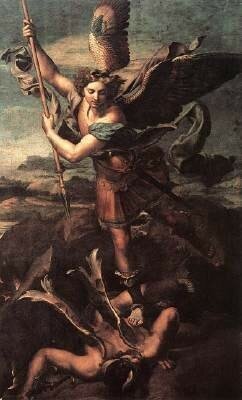 Diffused
quickly in Italy since the East, especially in the high and solitary
places, the worship was established in Vth and VIth centuries by
exiled Persans monks of their fatherland, sent by Rome to
évangelize the North of Italy. The presence of these monks is still
attested today by the dedication of a small vault with Saint Abacus,
one of their, by the Musiné Mount.
The Byzantines
developed the worship. Lombards celebrated it, them which had like
guards Saint Michael, Saint Pierre and Saint Ambroise.
Lenient
Rebora, one of the best representatives of the Religious Poetry of Xth
century, defines the Abbey of Saint Michel like a “vertiginously sacred top”.
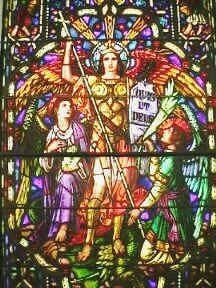 The
Abbey is closely related to the figure of Saint Michael , considered as the
prince of the celestial militia and as the right arm of the divinity.
The chronicler of the Abbey proposed already this particular
description of Saint Michael when he wrote, in the half of the eleventh
century, the following worms: “Thanks to several documents of the Holy
Scriptures, we know now that not only the Happy Michael has, thanks to
the will of God, the supremacy of the celestial militia, but it also
has, so to speak, a principality on the ground, which is, more exactly,
in the Western regions.
 the
Archangel chose himself between all three particular places in these
Western areas of the world, to visit them, and to flood
them his light: the first with the Gargan mount, already very known of
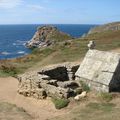
the whole world; the second close to the ocean, which one calls "
the danger of the sea”; the third placed very exactly halfway, it is
the Pirchirianus mount, in the middle of the high mountains, where it
is possible to contemplate the divine majesty more closely”.